Cardboard & Paper Recycling for Sydney Businesses
Collection and recycling of cardboard, paper and packaging waste — right-sized bins, balers or compactors, reducing your landfill footprint and helping you meet sustainability targets.
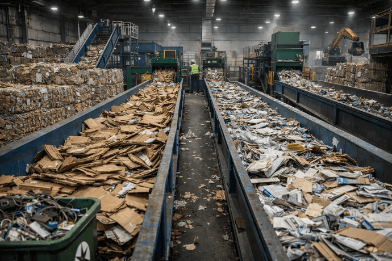
Baled cardboard is ready for pulping into new paper products
What Is Cardboard & Paper Recycling?
Cardboard and paper recycling is the source-separated collection of cardboard boxes, packaging, office paper and related materials, kept apart from general waste and other recyclables so they can be pulped and reprocessed into new paper products rather than sent to landfill. Businesses generating high volumes — retailers, warehouses, logistics operators — typically move beyond a wheelie bin to a compactor or baler, which reduces collection frequency and can turn cardboard into a revenue stream rather than a cost.
Clean Waste supplies bins, compactors and baler collection for cardboard and paper across Sydney, under one account alongside your general waste, recycling and other streams — with free advice on whether a baler makes sense for your volume.
Cardboard & Paper, Handled Efficiently
The right setup reduces both your cost per collection and how often you need one.
From Assessment to Ongoing Collection
Here's exactly what happens when you set up cardboard and paper recycling with Clean Waste.
Free Site Assessment
We review your cardboard and paper volume, storage space and floor layout.
Right Equipment Recommended
Bin, compactor or baler — matched to your volume, not a one-size-fits-all default.
Delivery & Setup
Equipment is delivered and positioned, with staff guidance on correct use if needed.
Scheduled Collection
Collections run on a schedule matched to your fill rate, not a fixed generic frequency.
Recycling Outcome
Material is pulped and reprocessed, with volumes documented for your reporting.
Bins, Compactors & Balers
The right equipment depends on how much cardboard and paper your site actually generates each week.
What Can & Can't Go in a Cardboard Bin
Contamination is the main reason loads get downgraded or rejected — correct sorting keeps recycling rates high.
✅ Accepted
- Cardboard boxes, flattened where possible
- Packaging cardboard and cartons
- Office paper, envelopes and printed materials
- Newspapers and magazines
- Paper bags (clean, no plastic lining)
- Cardboard tubes and cores
❌ Not Accepted
- Food-contaminated or wax-coated cardboard
- Plastic-lined or foil-lined packaging
- Polystyrene and bubble wrap
- Wet or mould-affected paper
- General waste or co-mingled recycling mixed in
- Shredded confidential paper (ask about our document destruction service)
Flattening & Loading Tips
A few basics reduce how often you need collection and improve your recycling outcome.
- Flatten every box: Un-flattened cardboard fills a bin with mostly air, tripling how often it needs collecting
- Keep it dry: Wet cardboard loses strength and can contaminate an otherwise clean load
- Remove packing material: Bubble wrap, foam and plastic liners should go to general waste or a dedicated plastics stream
- Separate confidential paper: Sensitive documents should go through a secure destruction service, not the recycling bin
- Consider a baler at scale: If you're filling a large bin more than twice a week, a baler is usually worth the conversation
What Drives Your Cardboard & Paper Cost
Clear quotes, no hidden fees — and at high volumes, baled cardboard can offset your costs.
Typical per-lift cost for a 240L–660L cardboard bin in Greater Sydney.
Typical per-lift cost for a 1.1m³–3m³ front lifter cardboard bin.
Compactor and baler setups are quoted per site based on volume, with potential rebate at scale.
Pricing depends on bin size, frequency, equipment type and volume. Request a free, itemised quote and we'll confirm your exact cost after a no-obligation site assessment.
Cardboard & Paper Recycling for Every Sector
Every industry generates cardboard differently — from occasional office paper to pallet loads of packaging.
Cardboard & Paper Recycling Across Greater Sydney
Consistent, on-schedule collection wherever your site is located.
Cardboard & Paper Recycling FAQs
Straight answers to the questions Sydney businesses ask most before setting up a service.
What's the difference between a bin, a compactor and a baler?
A bin is collected and emptied on a schedule, suited to moderate volumes. A compactor crushes cardboard on-site to reduce collection frequency. A baler compresses cardboard into dense bales, which can reduce collection needs further and, at high volumes, generate a rebate rather than a cost.
Does flattening cardboard actually make a difference?
Yes, significantly. Un-flattened boxes trap air and fill a bin's volume far faster than flattened cardboard, meaning more frequent (and costlier) collections for the same amount of material.
Can food-contaminated cardboard be recycled?
No. Food-contaminated or wax-coated cardboard, along with plastic or foil-lined packaging, contaminates a load and should go to general waste instead.
Is a baler worth it for my business?
Generally, if you're filling a large cardboard bin more than a couple of times a week, a baler is worth discussing — it reduces collection frequency, frees up floor space, and at sufficient volume can offset costs through a rebate on baled cardboard.
What should I do with confidential paper instead?
Confidential or sensitive documents shouldn't go in a standard recycling bin — they should go through a secure document destruction service with a Certificate of Destruction for compliance purposes.
How much does cardboard and paper recycling cost in Sydney?
Per-lift costs for a 240L–660L bin typically range from $20–$45 in Greater Sydney, with 1.1m³–3m³ front lifter bins ranging from $70–$140. Compactor and baler setups are quoted per site. Contact us for a free, itemised quote.
Set Up Cardboard Recycling Today
Free site assessment. Bins, compactors or balers. Fully documented, every collection.